Showing posts with label SQL Server. Show all posts

Tuesday, 20 March 2012

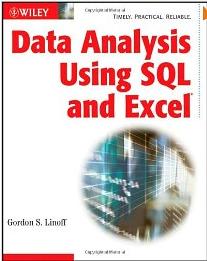
Data Analysis Using SQL and Excel

Knowledge into effective action is required for business analysis tools. This book and business information extracted from relational databases to store data to identify aspects of business transactions and offer customers more to use it to help you use SQL and Excel. When and why do the design and analysis using SQL and Excel to obtain useful results, and results should be similar to how the company to perform some type of analysis are described in each chapter.

Back cover

Harness the power of SQL and Excel to perform business analysis

Three major efforts are required for efficient conversion of knowledge to action: Import data from Excel data with SQL, the presentation and understanding of statistics as the basis for data analysis. Data mining expert Gordon Linoff focuses on these issues, SQL and shows you how to use Excel to extract business information from relational databases. Start taking a look at the amount of data, customers, products and markets is central to the task of understanding the dimensions of business relationships to customers and then the store will show you how to use these data to identify and summarize important data to produce results. On the way, it aims to improve understanding of why some things work and others' stories based on personal experience in the field, to share.

When and why to design and how to perform the analysis using SQL and Excel to obtain useful results and outcomes for what they can expect to look like some type of business to conduct the analysis described in each section. Throughout the book, the essential features of Excel are highlighted, interesting uses of Excel graphics are explained, and processing of data streams and graphical representation of data in SQL Server is used to show you how.

SQL and Excel, SQL, and advice to share data analysis / mining on the Excel Data Analysis Using Alerts and technical asides. The book discusses:
  • How to describe the structure of an entity-relationship diagrams, data
  • Ways to use SQL to create SQL queries
  • This means, as the descriptive statistics and chi-square p-values
  • How to analyze data, including geographic information
  • The basic ideas of risk and the probability of survival
  • Data structures, how to summarize what he looks like a client at some point in
  • Several variants of linear regression
  • Companion Website, data sets, Excel spreadsheets and provides examples in the book.

About the Author

Gordon S. Linoff data miners, Inc., a consulting firm specializing in data mining is one of the founders. Data mining techniques that bestseller, Second Edition, and Mastering Data Mining (Wiley both) is co-author. This, customer relations, marketing and managing the implementation of data mining techniques to business problems that have more than a decade.

Thursday, 1 March 2012

The Microsoft Data Warehouse Toolkit: With SQL Server 2008 R2 and the Microsoft Business Intelligence Toolset

Valuable best practices and expert advice from world-renowned data storage

In this book, from Kimball the best group of leading experts in data storage applications, SQL Server called SQL Server 2008 R2, the next "liberation Business Intelligence," to use. This new edition, writers, SQL Server 2008 R2, Excel and SharePoint users with powerful new tools for the collection and increases the power of BI tools to build a warehouse to show you how to use SQL Server to explain how the data provided to meet the needs of business intelligence that are common to most organizations. R2, SQL Server 2008 data warehouse and BI tools that are part of a complete suite of Microsoft Office, including the design of the authors, development, installation and maintenance, including the project cycle, full life, walk.
  • Equipment with over 50 percent of the new and the new Office 2010 version of SQL Server 2008 R2 and revised to cover the rich feature set
  • Excel and SharePoint, Master Data Services and SQL Server to include new content focusing on Analysis Services, Integration and Information Power Pivot examines the capabilities of the updated
  • Actions to implement the techniques described in the book clearly show how the detailed case studies
  • The accompanying code examples and case studies are used throughout the entire site containing the database

Microsoft Data Warehouse Toolkit, Second Edition, when and how to perform basic tasks of data storage such as Analysis Services and Integration Services provides information on the use of BI tools.
Back cover
To create a data warehouse Learn to use SQL Server 2008 R2

Data warehousing and business intelligence industry that the most effective leaders Kimball Group DW / BI systems design, development and management industry has developed standards of service as pioneer techniques. SQL Server 2008 R2: With this new version of his bestseller, experts in the use of veterans group Kimball catch up with the version of SQL Server Business Intelligence. Data warehouse and BI tools that are part of SQL Server 2008 R2, covering the full set, the authors design, development, implementation and maintenance, including monitoring the lifecycle of the project.

A major update to the previous edition and the new features and content and master data services such as eyes Power Pivot in addition to the functionality of SQL Server 2008 R2, this new version includes detailed examples showing how to apply best available techniques described in the book. The authors, trial, and a system of DW / BI with Microsoft tools can benefit their own challenges and successes gain share of the error of their own experiences. DW / BI lifecycle of the system to build Kimball discover how to use incentives to focus on four main principles: focus on your business, an information infrastructure, buildings and all meaningful increments delivered solution. With these principles in the hands of a successful DW / BI system supports the common needs of business intelligence to build the institutions will be well on your way.

DW / BI Data Warehouse Toolkit, Microsoft, Second Edition shows you how your role in the process of working on a project, no matter what:
  • Concentrate your efforts on best opportunities
  • Choose 2008 R2 and other Microsoft products, you can install and configure the components of SQL Server available
  • A three-dimensional model to design and create a relational database structures and database Analysis Services
  • Establish databases Integration Services ETL system to fill a DW / BI
  • BI applications to deliver value to your organization and create data mining models
  • Manage; maintain the system long-term success, and DW / BI growth
  • Microsoft SQL Server 2008 R2 and all business intelligence tools

Monday, 13 February 2012

Building a Data Warehouse: With Examples in SQL Server

Building the Data Warehouse: With Examples in SQL Server describes how to create a data warehouse completely from scratch and shows practical examples on how to do it. Author Vincent Rainardi solutions and advice along with developers, the first data warehouse project, discusses some practical problems are likely to encounter. SQL Server 2005 or later used in the examples and the system user relational database (RDBMS), SQL Server, the version will not be a problem as long.

The book is organized as follows. This book (Part 1 6) at the beginning, for example, architecture definition, design patterns data to understand the methodology of requirements gathering, how to build a data warehouse and creating databases data. Then, in Section 7-10, for example, how the source to fill the system with the data store for data quality and use of metadata to facilitate the loading of data stores. After completing the data warehouse, in Chapters 11 to 15, reports and multidimensional databases and how the data warehouse, business intelligence, relationship management, customer data transmission, and explore ways to provide users with data for others. Sections 16 and 17 to wrap the book: After creating a data warehouse before being released to production, you should test it thoroughly. Production after the application, you must understand how to manage the operation of data storage.

What you will learn
  • To create a data warehouse, a thorough understanding of what you need
  • Application code to create the data store in SQL Server
  • Three-dimensional modeling, methods of data mining, overhead data storage, filling the size and the fact tables, data quality, architecture and data warehouse database design
  • This kind of business intelligence reports, analysis and data storage 
  • Practical applications such as customer relationship management,
For whom is this book?

There are three types of audience for the book. People who participate in the first data memory. In what they can be considered a guide for a field. The second about what it would take to create a data warehouse, I want to have a good idea those users of databases or administrators. The third hearing, the governance aspects of the task before them to make decisions about data storage, and use books to learn about these issues is essential.